Table of contents
In today’s ultra-competitive retail landscape, customer loyalty can’t rely on outdated point systems or generic promotions. To truly boost engagement, brands are turning to loyalty gamification – enhanced by real-time data and smart personalization – as a strategic growth driver.
Data-driven gamification combines the psychology of game mechanics with advanced retail loyalty technology, creating dynamic, personalized experiences that reflect how customers actually behave – online and offline. These aren’t just marketing gimmicks; they’re optimized systems that use behavior analytics to improve conversion, retention, and purchase frequency.
I’m a Business Developer at Droids On Roids. My job is to drive direct sales at the company, however, I spent some time working with loyalty software in the past, specifically helping the biggest brands implement enterprise-level loyalty programs. That’s why I can share some insights about how the most effective loyalty programs work.
If you’re a founder, product owner, or marketing lead, this guide is built to help you design gamified loyalty programs that are both impactful and measurable. You’ll learn how to leverage customer insights, choose the right tech stack, and track ROI across multiple touchpoints.
We’ll also break down real-world strategies from leading brands and outline a practical roadmap for implementation – helping you move from concept to conversion with confidence.
What is data-driven loyalty gamification?
At its core, loyalty gamification uses game mechanics – points, badges, leaderboards, and challenges – to encourage repeat behaviors. But the real power of gamification in 2025 lies in how it’s fueled by data.
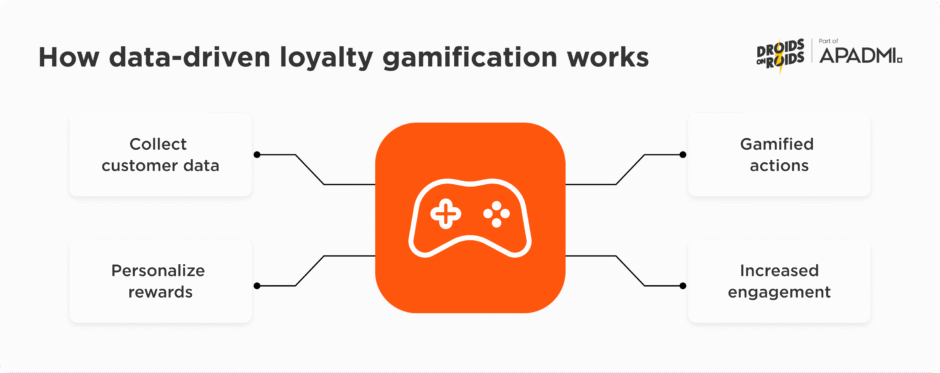
Data-driven loyalty gamification is where engagement meets intelligence. Instead of offering the same rewards to everyone, modern systems leverage retail analytics and customer data to personalize experiences in real time. For example, a high-frequency in-store shopper might get a location-based challenge, while a dormant app user might receive a reactivation quest tailored to their past purchases.
The key difference lies in optimization. Traditional loyalty programs are static. Data-powered programs continuously evolve based on how customers interact across channels. This creates a feedback loop where engagement drives insights, and insights drive conversion.
It’s not just about improving retention. It’s about aligning gamification with business goals like increased average order value, reduced churn, and higher customer lifetime value.
With the right data infrastructure, gamification becomes a revenue engine – not just a feel-good UX layer.
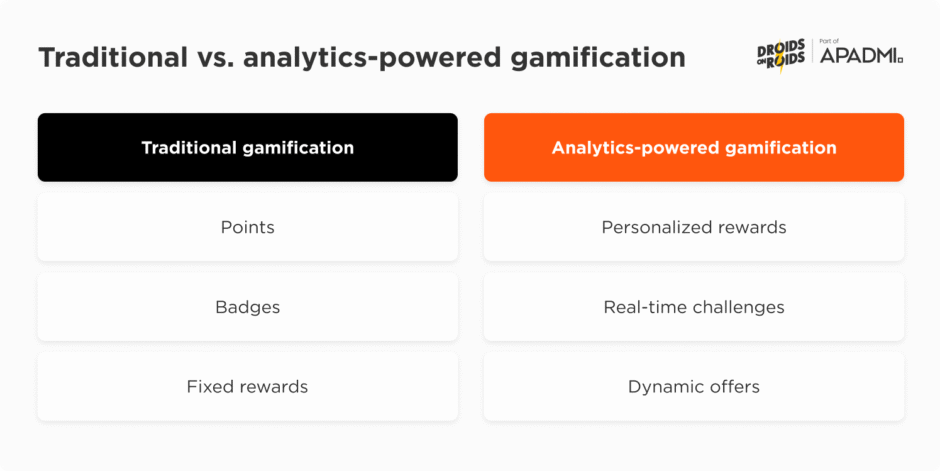
Traditional vs. analytics-powered gamification
Traditional gamification relies on pre-set rules: spend more, get more. But without analytics, it’s hard to know what’s working. Analytics-powered gamification, on the other hand, uses customer data to test, adapt, and scale strategies based on what actually moves the needle.
It enables:
– Conversion tracking tied directly to gamified actions
– Personalization based on behavior and engagement level
– Data-backed ROI measurement and real-time campaign adjustments
This isn’t about guessing. It’s about precision and performance.
The role of customer data in modern gamification
Modern gamification depends on the depth of retail behavior data. This includes:
– In-store movement via geolocation and beacons
– Transaction history and product preferences
– App engagement metrics like screen flow and time spent
These insights fuel personalization engines that serve relevant challenges and rewards. The result? Better engagement, smarter upselling, and stronger loyalty – all backed by customer analytics instead of assumptions.
Essential technology stack for loyalty gamification
Behind every successful loyalty gamification strategy is a well-integrated, scalable tech stack. It’s not just about implementing points and badges – it’s about using the right tools to collect data, deliver real-time personalization, and measure outcomes across the customer journey.
To build a truly responsive gamified loyalty program, retail businesses need infrastructure that supports behavioral tracking, omnichannel communication, and continuous optimization. That means more than just adding a gamification plugin. It requires a layered retail tech stack that connects core systems like POS, CRM, analytics platforms, and mobile apps into one unified loop.
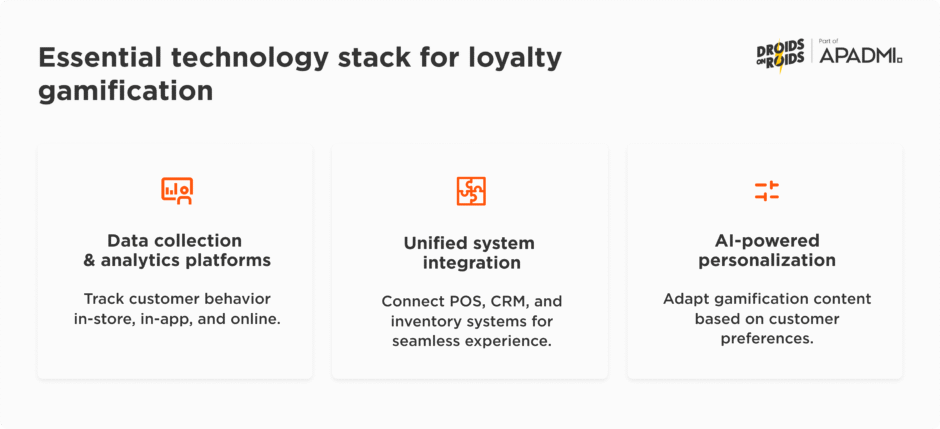
Let’s break it down into three essential technology pillars.
Data collection and analytics platforms that power loyalty gamification with real-time customer behavior tracking
Loyalty gamification only works when you know what your customers are doing – and why. You need platforms that capture user activity across touchpoints: in-store, in-app, and online. These systems should surface insights like campaign engagement, redemption behavior, and reward fatigue. With a solid loyalty analytics platform, you’ll be able to analyze trends, test mechanics, and optimize faster.
Seamless integration with retail systems including POS, CRM, and inventory to unify gamified experiences
If your loyalty program exists in a silo, it will fail. Real-time retail system integration ensures loyalty points sync at checkout, rewards reflect inventory status, and customer profiles update across CRM and marketing systems. This unified infrastructure is what enables omnichannel loyalty technology to actually feel seamless to the end user.
AI-powered personalization engines that adapt gamification content based on customer behavior and preferences
Personalization is the secret weapon of modern AI loyalty programs. Machine learning models can segment customers by intent, predict next actions, and adapt game mechanics dynamically. Whether it’s serving a location-triggered challenge or creating time-sensitive rewards, these engines make personalized gamification scalable and effective.
Download our AI-driven Personalization Readiness Assessment to understand your organization’s true level of personalization
Measuring ROI and business impact of loyalty gamification
Launching a gamified loyalty experience is a solid move – but tracking its real business impact is what separates smart execution from wasted effort. Whether you’re running a DTC app, an omnichannel commerce platform, or a subscription-based business, measuring ROI is essential to scale what works.
The best loyalty gamification ROI strategies are built on data, not assumptions. That means going beyond basic engagement stats and understanding how specific mechanics affect key outcomes – like user retention, purchase frequency, upsell conversion, and lifetime value.
To do this right, you’ll need a measurement framework that covers three pillars: performance indicators, analytics models, and iterative testing.
Key performance indicators for gamified loyalty programs in a retail environment
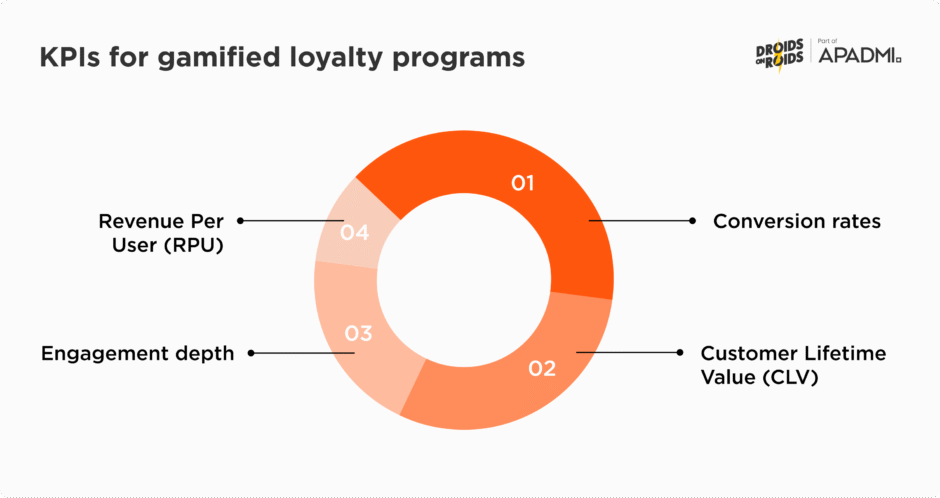
Skip vanity metrics. Focus on loyalty program KPIs that show real movement in user behavior and revenue. These include:
- Uplift in conversion rates triggered by gamified CTAs
- Growth in customer lifetime value (CLV)
- Engagement depth: average session duration, repeat challenges, feature re-entries
- Revenue per user (RPU) before and after gamification
- Challenge completion and reward redemption rates
These conversion metrics apply whether you’re optimizing an in-app journey or driving in-store behavior.
Using attribution modeling and cohort analytics to understand true impact of loyalty gamification
To prove causality, you need attribution – not assumptions. Techniques like:
- Multi-touch attribution across app, email, and offline channels
- Cohort analysis to observe changes in repeat behavior over time
- Predictive lifetime value modeling based on engagement signals
These retail and digital analytics practices help you isolate gamification’s real impact on user behavior and revenue.
Running a/b tests and iterative optimization cycles to refine gamified elements
Every gamification mechanic is a testable hypothesis. Use structured A/B testing to compare:
- Game types (e.g. quests vs. streaks)
- Reward tiers and thresholds
- Language and triggers
Make sure to track significance, control group behavior, and long-term retention impacts. Gamification isn’t set-it-and-forget-it – it’s an evolving, conversion optimization engine.
Customer segmentation and behavioral targeting in gamified experiences
The success of customer segmentation gamification lies in how well you understand who your users are – and how differently they behave. Not all customers respond to the same rewards, messaging, or challenge types. Some are loyal browsers. Others respond to urgency. Some only engage after a social nudge.
By tapping into behavioral targeting, brands can design gamification experiences that feel personal, timely, and genuinely rewarding. This leads to stronger engagement, more conversions, and significantly higher retention – whether you’re running a retail rewards app, a fitness subscription, or a gamified fintech onboarding journey.
Segmentation lets you stop guessing and start aligning your gamified mechanics with actual user motivations. The result? More relevance, less noise, and a measurable lift in key business metrics.
Segmenting users based on shopping patterns, engagement levels, and interaction preferences
Effective behavioral segmentation isn’t about demographics – it’s about how people act. Use customer data to profile users by:
- Frequency and recency of purchases or logins
- Feature usage patterns and depth of engagement
- Completion rates for past gamified actions
- Preference for short-term vs. long-term goals
This level of customer profiling helps you deliver loyalty experiences that resonate – not just reward.

Delivering real-time gamification content with dynamic personalization at scale
With the right data and infrastructure, dynamic personalization can power real-time gamification layers. That means delivering content like:
- Location-triggered missions
- Streak rewards for power users
- Re-engagement nudges based on churn risk models
Whether you’re personalizing quests, offers, or leaderboard placement, smart real-time content delivery turns your program from generic to genuinely habit-forming.
Mobile-first implementation strategies for loyalty gamification
In 2025, mobile isn’t just a channel – it’s the core touchpoint for most customer interactions. From check-ins to purchases, gamified experiences live and breathe through smartphones. That’s why mobile loyalty gamification needs to be designed from the ground up with mobile-first thinking.
Apps offer a unique opportunity: always-on access, real-time context, and native hardware features like location tracking and push notifications. Done right, this enables loyalty mechanics that feel intuitive, immediate, and hyper-personalized.
Whether you’re gamifying an e-commerce experience, a physical retail visit, or an app-based challenge, building with retail app technology opens up new engagement layers you simply can’t get through email or desktop alone.
Let’s break it down into three areas of mobile-first execution.
Mobile gamification features like push notifications and in-store interactions that boost app engagement
Design your mobile gamification features to work natively with mobile habits. Push notifications can remind users of expiring rewards. Camera integrations can support AR-based scavenger hunts. QR code check-ins and scan-to-earn mechanics boost retail app engagement at physical locations.
Location-based gamification using geofencing and beacons to connect physical presence with digital rewards
By enabling location-based gamification, you can reward customers just for showing up. Use geofencing to trigger check-in bonuses or in-store missions. Add retail technology integration like beacons to unlock proximity-based perks or notify users of nearby challenges when they pass a storefront.
Designing gamified loyalty experiences that stay consistent across mobile, web, and in-store channels
Customers don’t think in channels – they expect one fluid journey. That’s why omnichannel gamification must deliver seamless transitions across devices and locations. A mission started on mobile should sync with in-store actions or desktop behavior. Unified tracking ensures cross-platform loyalty makes sense, feels smooth, and drives results.
Conversion optimization through game mechanics that influence buying behavior
Gamification doesn’t just drive engagement – it directly impacts how and when people buy. By applying the right mechanics at the right moment, brands can reduce friction, increase urgency, and create loyalty loops that lead to higher conversion and retention.
Whether you’re running an e-commerce platform, a mobile-first subscription app, or an omnichannel loyalty program, conversion optimization gamification helps turn passive users into active buyers. But it has to be intentional. Not every spin-the-wheel or badge will move the needle – it’s about aligning game design with actual purchase behavior analytics.
Let’s look at two critical areas: purchase incentives and retention-driven game loops.
Using purchase-driven game mechanics to increase transaction rates without undermining trust
Smart purchase gamification can incentivize buying without feeling manipulative. Examples include:
- Unlocking a reward tier after hitting a spend threshold
- Earning bonus points for trying a new product category
- Running time-limited quests tied to cart completion
These conversion mechanics reduce abandonment and drive intentional behavior while still respecting the user experience.
Retention-focused game strategies that increase repeat purchases and long-term engagement
The real ROI of gamification is in its retention gamification potential. Use streak rewards, surprise-and-delight mechanics, or level-based loyalty tiers to keep users coming back. Layer in repeat purchase optimization triggers like replenishment reminders or monthly challenges to build predictable buying cycles.
Real-world implementation case studies of successful loyalty gamification
Gamification works best when it’s grounded in real customer behavior and measurable outcomes – not just creative ideas. Some of the world’s most successful brands have already proven how loyalty gamification can drive engagement, increase revenue, and strengthen customer lifetime value.
The following retail success stories demonstrate how different approaches to technology, data integration, and personalization have delivered results. From AI-powered rewards to omnichannel data loops, these implementation case studies provide a blueprint for what scalable, data-driven gamification really looks like in practice.
Starbucks using AI and data to deliver personalized gamification at massive scale
The Starbucks app is one of the most advanced AI personalization retail platforms in the loyalty space. Its gamified challenges, point-based missions, and time-sensitive offers are all dynamically adjusted using customer data – including purchase frequency, drink preferences, and visit times.
This Starbucks loyalty technology stack includes machine learning models that tailor promotions to the individual, resulting in high engagement and consistent upsell performance. Starbucks has publicly reported that its Rewards members drive nearly 57% of US store revenue – a clear ROI signal.

Sephora’s omnichannel loyalty integration for unified online and offline engagement
Sephora’s retail integration strategy connects e-commerce behavior with in-store activity to deliver consistent, gamified rewards. Their Beauty Insider program is powered by omnichannel loyalty data, enabling actions like earning points via in-app tutorials or receiving personalized discounts in-store based on prior online behavior.

This creates a seamless user journey, maximizing engagement while driving conversion across platforms.
Nike leveraging lifestyle data and community-based gamification for brand affinity
Nike’s loyalty strategy centers on lifestyle tracking – not just transactions. Through apps like Nike Run Club and Nike Training Club, the brand uses lifestyle data gamification to reward users for fitness milestones, social sharing, and long-term engagement.
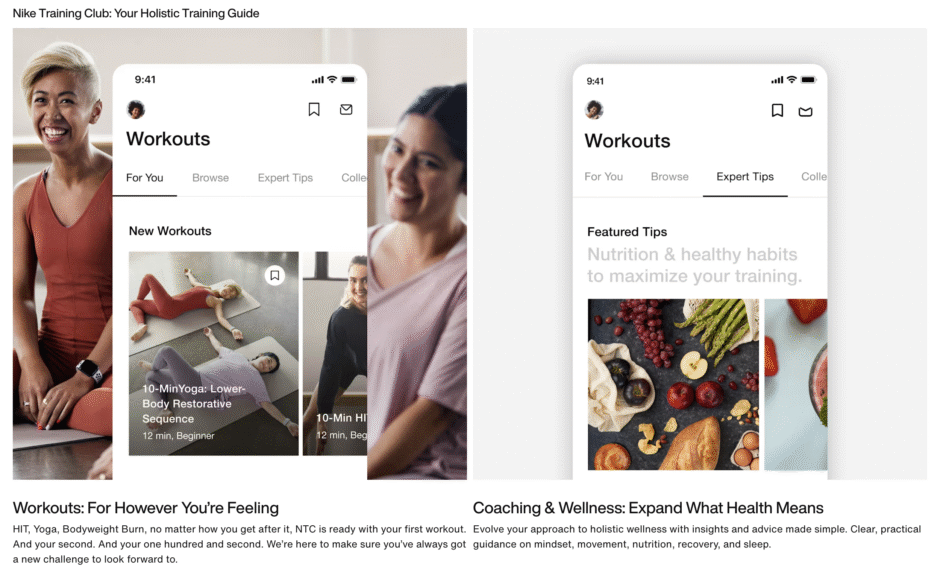
By connecting community loyalty programs with product offers and early-access perks, Nike transforms everyday workouts into emotionally sticky brand experiences that fuel repeat purchases and social advocacy.
Implementation planning and resource requirements for loyalty gamification
Before gamification can deliver business value, it needs to be implemented with precision. Poor planning can lead to disjointed experiences, tech debt, or platforms that can’t scale. Whether you’re launching a loyalty app or integrating gamification into an existing system, strong gamification implementation planning is non-negotiable.
This means evaluating technology options, aligning internal resources, and ensuring your retail tech investment supports long-term goals. Below is a breakdown of what to address before you build.
Assessing loyalty platforms, scalability, and vendor capabilities before making a tech decision
Choosing the right partner starts with a structured evaluation of loyalty technology vendors. Consider platforms that offer API-first architecture, proven platform selection flexibility, and prebuilt integrations with CRM, POS, and analytics tools. Scalability should be a top priority – you’ll need to support growing user bases and evolving features.
Structuring your gamification team with the right balance of design, data, and technical skills
A high-performing gamification team structure includes:
- Product or loyalty owner to align goals
- Data analysts to drive insights and modeling
- UX/game designers for engagement architecture
- Technical leads for API and system implementation skills
Cross-functional collaboration is key to executing fast and iterating early.
Planning budgets and projecting ROI based on scope, tooling, and business goals
Successful gamification budget planning includes:
- Platform licensing and usage fees
- Development and integration costs
- Design and analytics resource time
Factor in an ROI window of 6–12 months depending on your funnel. Set measurable KPIs and revisit your ROI projections quarterly to ensure alignment.
Data privacy and compliance considerations for loyalty gamification
As gamified experiences become more data-rich and personalized, so do the risks associated with mishandling that data. Founders and product leaders must ensure that gamification systems meet the highest standards of loyalty data privacy and ethical usage – especially when dealing with sensitive behavioral or location-based information.
Regulations like GDPR, CCPA, and evolving global standards require a gamification compliance framework that’s baked in from the start – not tacked on as an afterthought. Beyond legality, there’s also trust: customers need to feel that their information is being used fairly, transparently, and with their consent.
Whether you’re building in-house or working with a third-party loyalty provider, the approach must center on customer data ethics and future-proof compliance practices.
Designing privacy-first gamification that respects regulations and user control preferences
Implement privacy-first loyalty mechanics by default. This includes:
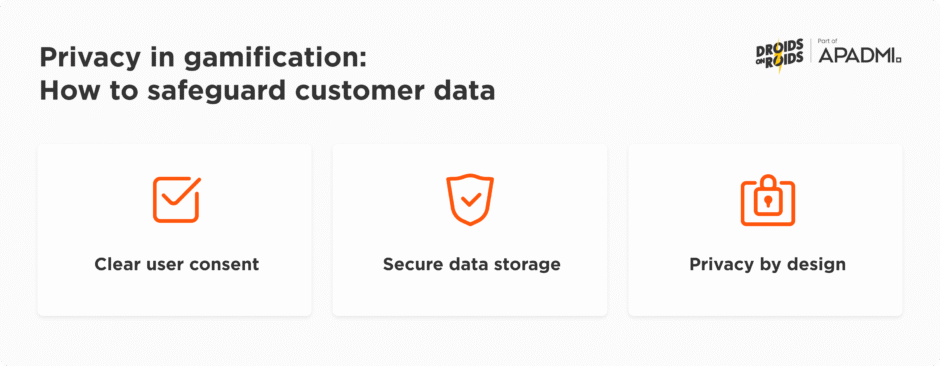
- Clear consent and opt-in for data collection
- Tiered personalization levels with user choice
- Gamification logic that adapts even when data is limited
Strong data protection gamification design builds trust and keeps you legally sound.
Building a security and compliance framework into your loyalty technology stack
A solid compliance framework should include:
- End-to-end encryption and secure APIs
- Regular audits of third-party integrations
- Role-based access to sensitive data
These loyalty security measures ensure personalized gamification never comes at the cost of user safety or regulatory risk.
Future of retail loyalty technology and the next generation of gamification
Loyalty programs are evolving fast – and gamification is at the heart of that transformation. What started as point systems and digital punch cards is now expanding into AI-driven decisioning, AR-powered experiences, and predictive engagement tools.
The future loyalty technology stack will be increasingly intelligent, immersive, and automated. It won’t just react to customer behavior – it will anticipate it, optimize in real time, and create moments that feel genuinely tailored to each user’s context.
For product and marketing teams, staying ahead means understanding not just what’s working now, but which retail innovations will shape the next generation of emerging gamification.
AI and machine learning driving loyalty personalization and customer journey intelligence
The AI loyalty evolution is already here. Machine learning enables platforms to analyze behavior patterns and deliver ultra-relevant challenges, rewards, or nudges – often without human input. Machine learning retail systems also help map and adapt customer journeys dynamically as engagement evolves.
Integrating immersive technology like AR and VR into loyalty-driven experiences
AR retail gamification opens up new channels for engagement – like scanning products for rewards, completing in-store missions via AR overlays, or exploring virtual storefronts. These immersive loyalty experiences are poised to redefine how users interact with brands.
Using predictive analytics and automation to optimize gamification before users disengage
Predictive loyalty analytics allow brands to intervene before churn or fatigue sets in. Combine that with automated optimization tools, and your gamification engine becomes self-tuning – reacting to what works in real time and adapting without waiting for a manual update.
Getting started – implementation roadmap for loyalty gamification
You don’t need to build a full-featured loyalty system on day one. A phased, strategic rollout is key to success. This gamification implementation roadmap outlines how to move from concept to live product – with data, testing, and iteration baked in at every step.
Whether you’re adding gamification to an existing retail app or building a net-new platform, the following framework helps structure your retail loyalty strategy around value, speed, and scalability.
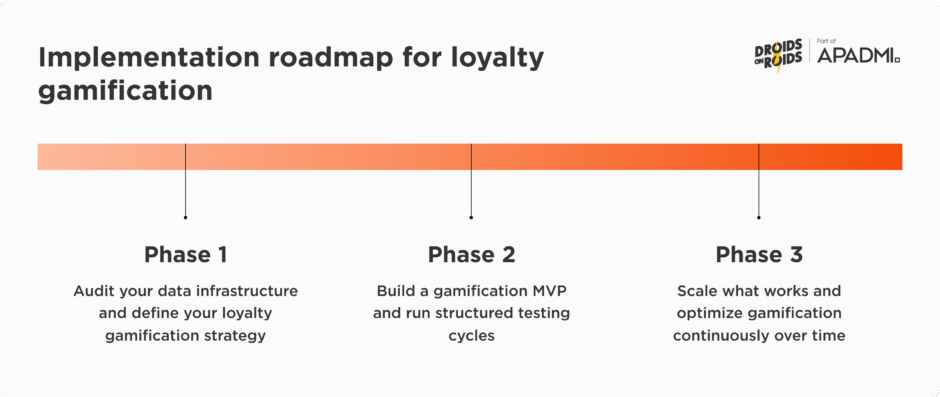
Phase 1 – audit your data infrastructure and define your loyalty gamification strategy
Start by assessing your loyalty data infrastructure. Where does your customer data live? Is it clean, accessible, and unified across touchpoints?
From there, define your implementation strategy – choose your KPIs, select technology partners, and outline how gamification will support customer and business goals. This phase should last 2–4 weeks for smaller teams, longer for enterprise.
Phase 2 – build a gamification MVP and run structured testing cycles
Don’t launch everything at once. Instead, design a gamification MVP: a basic reward loop, a simple challenge mechanic, or a tiered point system. Set up a testing framework to validate core assumptions, A/B test mechanics, and gather behavioral data before scaling.
Phase 3 – scale what works and optimize gamification continuously over time
Use insights from your MVP to guide gamification scaling. Add features like dynamic content, advanced segmentation, or seasonal campaigns. Your optimization processes should include ongoing testing, user feedback loops, and regular performance reviews.
Conclusion: Building sustainable data-driven loyalty
Loyalty gamification has evolved far beyond points and punch cards. Today, it’s a system – one that blends behavioral insights, intelligent technology, and user-centric design to create long-term value for both businesses and customers.
But building sustainable loyalty gamification doesn’t come from flashy mechanics alone. It requires a structured approach to data, seamless system integration, and continuous optimization across channels and segments.
If there’s one principle that underpins success in this space, it’s iteration. The best-performing loyalty strategies are never static – they adapt, evolve, and respond to real-time customer behavior.
Whether you’re running an enterprise retail platform or scaling a B2C app, putting data at the center of your gamification engine unlocks more than engagement. It powers data-driven customer success – with measurable ROI, stronger retention, and brand experiences your users actually want to return to.